

A ceiling fan does not lower the temperature of an empty room. It moves air across people, making a warm room feel more comfortable while they are there. That distinction matters when shopping: the most useful fan is one that fits the room safely, delivers comfortable airflow at a tolerable sound level, and is easy enough to control that people actually use it.
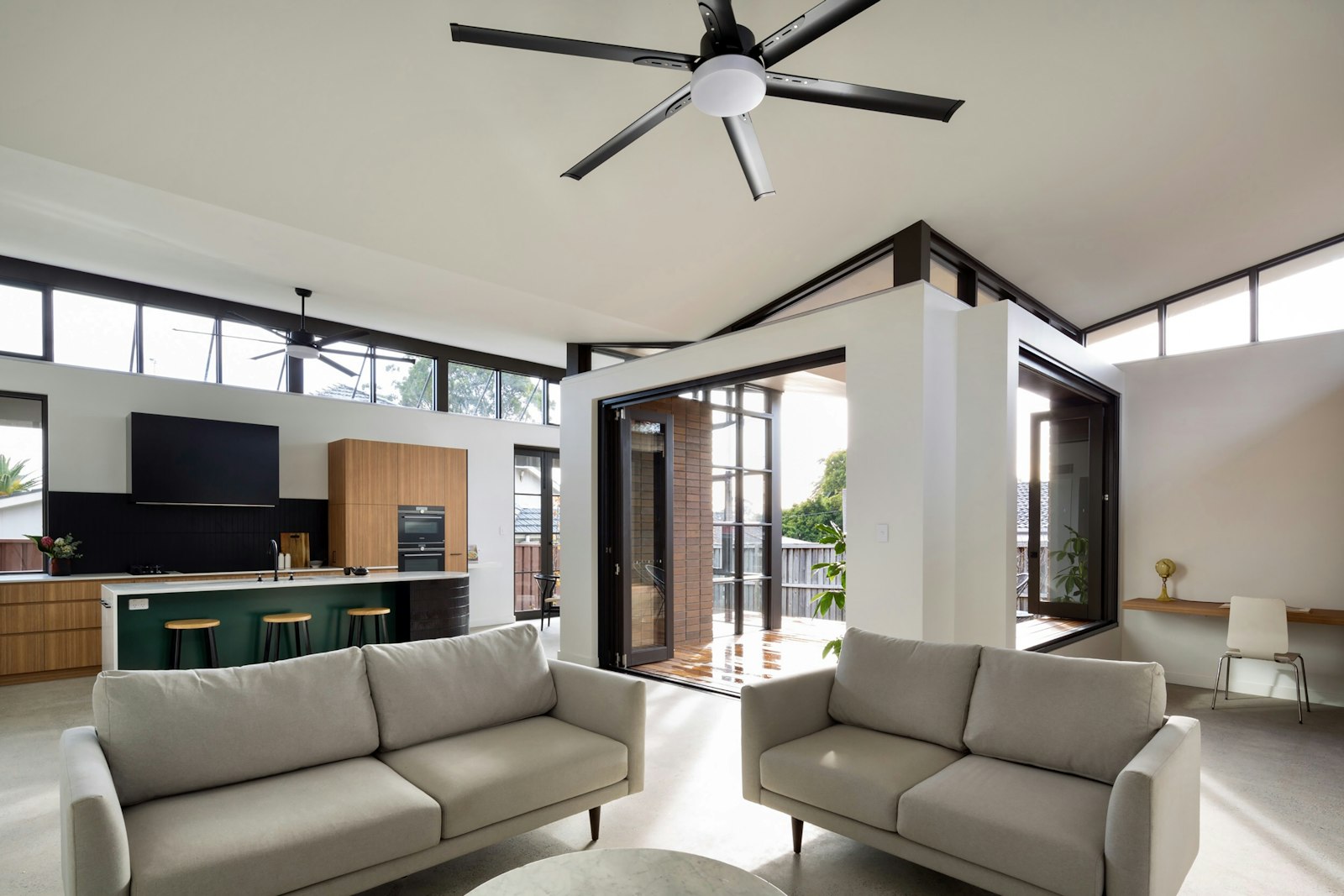
Catalog photographs emphasize blade finish and light fixtures. Start instead with the ceiling, room dimensions, and existing electrical setup. Those determine which fans belong on the shortlist. Appearance can settle the choice after the practical questions are answered.
Measure the room and the ceiling
Record room length and width, then note the height at the proposed mounting point. Sloped ceilings require special attention because the ceiling height changes across the blade sweep. Identify beams, tall cabinets, walls, and other obstructions.
ENERGY STAR offers a room-size guide: roughly 29–36-inch fans for rooms up to 75 square feet, 36–42 inches for 76–144 square feet, 44 inches for 144–225 square feet, and 50–54 inches for 225–400 square feet. Treat these as starting ranges, not substitutes for the fan maker's clearance requirements or the geometry of an irregular room.
A fan should be centered where people need the air, which may not be the geometric center of a long open-plan space. Two appropriately sized fans can sometimes serve separate seating areas better than one enormous unit.
Check blade clearance before style
ENERGY STAR advises at least seven feet from the floor to the fan and at least 18 inches from walls; eight to nine feet above the floor is its recommended range for airflow where the ceiling permits. Follow the specific manufacturer's instructions and applicable local electrical and building rules as well.
A low ceiling may call for a purpose-designed flush or hugger mount. A tall ceiling may need a compatible downrod so the fan is not stranded far above occupants. Do not substitute a generic rod unless the fan maker approves it. Sloped ceilings may require a rated angled mount and a downrod long enough for blade clearance.
Measure the clearance in the fully installed configuration, including any light kit. The nearest wall or tall cabinet may be closer to a blade than a simple floor plan suggests.
Understand airflow figures

Airflow is often listed in cubic feet per minute, or CFM, at a stated speed. A higher number can indicate more air moved, but comparisons should use the same speed and test conditions. Efficiency is commonly expressed as airflow per watt. ENERGY STAR publishes criteria for qualifying fans, making its label a useful comparison point rather than a promise that any one model will feel best in a particular room.
High-speed CFM does not tell you how pleasant the fan is at bedtime or during conversation. Look for low and medium settings, which are used more often in ordinary rooms. Blade pitch alone is not a reliable shortcut to performance; motor, blade design, diameter, and speed work together.
Ask whether the published figures cover the exact model and blade configuration under consideration. Different sizes within a product family can perform differently.
Treat noise as part of performance
A fan can make sound from its motor, blade movement, or vibration transmitted into the ceiling. An efficient motor is helpful but does not guarantee silence. Loose mounting hardware, unbalanced blades, and an unsuitable electrical box can cause rattling or wobble after installation.
If possible, listen to a running display at several speeds. Showroom background noise makes this imperfect, so read owner feedback for recurring descriptions of clicking or hum, not isolated complaints. Review the warranty for motor and other parts separately.
An improperly installed fan should not be accepted as “normal” just because it still moves air. Stop using a fan with new wobble, unusual noise, loose blades, or visible damage and have it inspected.
Choose controls for the household
Pull chains are simple but inconvenient on high ceilings or above a bed. Wall controls are easy to find, though installation may require suitable wiring. A handheld remote adds flexibility but needs a predictable storage spot and replaceable batteries. App controls can be useful, yet they should not make ordinary on/off operation dependent on an unreliable network.
Check control compatibility before purchase. A standard light dimmer is not necessarily suitable for a fan motor. Some fans use proprietary receivers or integrated electronics, which can complicate later repair. Confirm whether a replacement remote or receiver is available.
If separate fan and light control matters, determine whether the existing wiring supports it. A qualified electrician can explain the options without assuming the current switch configuration can be reused unchanged.
Decide whether you need a light
A combined fan and light is practical when the ceiling has only one central electrical position. But an integrated LED module may be harder to replace than conventional bulbs. Ask whether the module and driver are serviceable, their warranty terms, and whether the light output is sufficient for the room.
Check color appearance, dimming compatibility, and shade glare. A fan light placed over a dining table may provide general illumination yet still leave faces or work surfaces poorly lit. Layered room lighting remains useful.
If the fan will sit near a television or work desk, consider whether rotating blades interrupt light from other fixtures and create flicker or moving shadows.
Indoor, damp, and wet ratings differ
An ordinary indoor fan should not be installed on an exposed porch simply because the roof covers it. Product ratings distinguish dry indoor locations from damp covered areas and wet locations exposed to rain. Select the exact rating required by the site and follow mounting guidance.
Humidity and coastal salt can affect finishes and hardware even on a covered patio. Ask about the complete fan, including blades, motor housing, and light kit. An outdoor-looking finish is not a substitute for an appropriate electrical listing.
If an existing outdoor fan has corrosion, do not merely paint over it without assessing the structural and electrical components.
Installation requires the correct support
A ceiling fan is not simply a light fixture with blades. Its electrical box and mounting must be rated for fan support and the actual unit's weight. An old light-only box may be unsuitable. The circuit, wiring, grounding, and wall controls must match the manufacturer's instructions and applicable code.
This is a good place to use a qualified electrician if the existing box or wiring is uncertain. The cost belongs in the purchase budget. Ask the installer to confirm clearances, operation at every speed, lighting, and direction control before leaving.
Keep the manual, model number, and spare balancing kit. Registering the product can help with warranty service and recall notices, but it does not replace checking the model against official recall information.
Use direction settings thoughtfully
The U.S. Department of Energy explains that summer airflow can create a wind-chill effect and may allow a comfortable higher thermostat setting. Fans should generally be switched off when nobody is in the room because they cool people, not the room itself.
Some reversible fans can circulate warm air near the ceiling in winter, typically at low speed. The useful setting depends on the fan's design and room layout. Follow the owner's manual and avoid a draft that makes occupants less comfortable.
Changing direction is not a substitute for insulation, weather sealing, or appropriate heating and cooling. It is one small comfort tool.
Compare the installed cost
Price the fan, required downrod or angled mount, light kit, receiver or wall control, electrical box, installation, and any future replacement parts. A discounted fan can become expensive when the matching remote or integrated light module is proprietary.
Review return terms before installation. Some retailers limit returns of installed electrical products. Inspect the blades and finish on arrival, and confirm that the package includes all hardware listed in the manual.
Choose a design you can clean. Thick sculpted blades and enclosed shades collect dust in places that may be hard to reach from a ladder. Follow safe ladder practices and switch power off before maintenance.
A useful final checklist
The fan should suit the room's area, satisfy floor and wall clearances, use an approved mount and fan-rated electrical support, document airflow and efficiency, offer comfortable lower speeds, and have controls the household will use. The light, if present, should be serviceable or have clear replacement terms.
Once those conditions are met, choose the form that fits the room. A quiet, well-positioned fan in a modest finish is a better purchase than a dramatic one with poor clearance, awkward controls, or an installation nobody budgeted for.
Sources and further reading
- ENERGY STAR, ceiling fan basics and sizing: https://www.energystar.gov/products/ceiling_fans/ceiling_fan_basics
- U.S. Department of Energy, Energy Saver guide: https://www.energy.gov/sites/default/files/2022-08/energy-saver-guide-2022.pdf